
In collaboration with 
Madrid · Wednesday 9 December 2026 · The day after the DEC Global Summit
Stackable Credentials Forum
A one-day working forum for the people who set credit policy, run continuing and extended education, and build the systems that connect short credentials to degrees. The day works through one question. What has to be true for a short credential to become credit that another programme, institution or employer will accept?
It takes place the day after the Digital Education Council (DEC) Global Summit, held on 7 and 8 December at IE Tower, so delegates already in Madrid can stay one more day.
- Date
- Wednesday 9 December 2026
- Time
- 09:00–16:30 CET, then the Reina Sofía and dinner at NuBel
- Venue
- Salesforce office, Madrid
- Format
- In person
- Places
- 56, at 8 tables
- Organisers
- Tondro Consulting, in collaboration with Salesforce
Why this forum
Issuing the credential is the easy part
Most institutions attending already issue short credentials, and many call them stackable. The harder work comes later, in deciding which requirement the credit fills, who signs it off, what cap applies and whether learners go on to the next step.
Each system answers those questions differently. Spain caps recognition of non-official study at 15% of an official degree. Germany allows up to half of a degree to come from learning outside higher education. Estonia has written micro-credentials into statute. The US now ties Workforce Pell funding to stackable, credit-bearing credentials. The UAE’s national framework recognises short learning units as partial qualifications.
With people from several of these systems in one room, a single design can be tested against all of them. Most of the day is panel discussion and table work, with tables grouped by regulatory system and each design reviewed by practitioners from other regions.
Several deadlines fall in 2027. They include the European Commission’s report on the micro-credentials Recommendation, the revised European quality standards, England’s Lifelong Learning Entitlement and the US earnings accountability rule.
Programme
Times are Central European Time. Open a session for the questions it takes on.
- Design studio and cross-system review · 165 min
- Welcome and briefing · 60 min
- Demonstrations and questions · 55 min
- Panel · 45 min
- Close · 15 min
| Time | Session |
|---|---|
| 08:30 | Registration and coffee |
| 09:00 | Welcome and room pollPlenary A short opening, then a live poll answered on phones. The sessions that follow use the room’s results. What the session covers
|
| 09:15 | Briefing: thirteen systems, four regulatory patternsBriefing A 40-minute comparison compiled from public sources across North America, Europe, the Gulf, Central Asia and Asia-Pacific, then five minutes of table discussion. It is the shared reference for the rest of the day, with unverified points marked. A summary is further down this page. What the session covers
|
| 10:00 | Panel: who decides credit?Panel Practitioners who make or administer credit decisions, from three regions and three regulatory patterns. Each brings one rule from their own institution with a number in it. Panellists to be announced. What the session covers
|
| 10:45 | Break |
| 11:05 | Two pathways in a working systemDemonstration Tondro shows two stackable pathways built on Salesforce Education Cloud, each framed around a policy problem from the briefing. Credit is shown in ECTS and US credit hours, and the system applies the credit rules. What the session covers
|
| 12:00 | Lunch with hands-on stationsStations Two stations stay open over lunch. At one you go through a pathway as a learner, and at the other you evaluate and apply incoming credit as a registrar. |
| 13:15 | Design studio, part 1: what to stackTable work Tables of seven, grouped by regulatory pattern, each with a facilitator. Each table picks one real case from its members and works it through on a shared canvas. What the session covers
|
| 14:15 | Design studio, part 2: making it countTable workWhat the session covers
|
| 15:15 | Break |
| 15:30 | Cross-system reviewPlenary discussion Each table presents its stack in three minutes. A panellist from a different region then has two minutes to answer one question. Would you accept this credit at your institution, and if not, what would you need to see? |
| 16:15 | Close: what the tables foundPlenary The issues raised in review, grouped by credit rules, approval, records and funding, and set against the barriers the room named in the morning poll. |
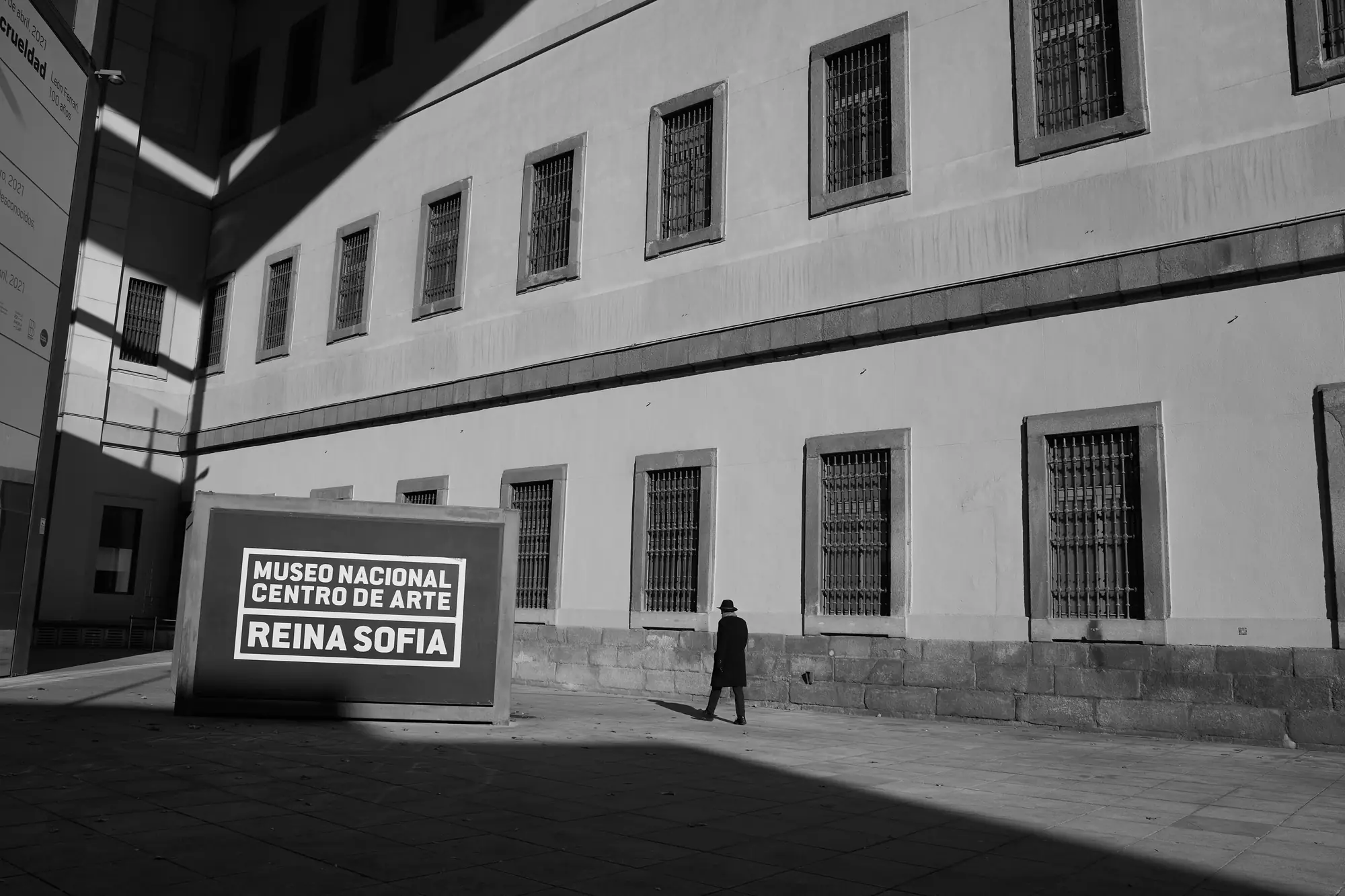
| After the close | Reina Sofía Museum tourEvening The Reina Sofía focuses on 20th-century contemporary Spanish art, heavily featuring Salvador Dalí, Joan Miró, and culminating in Picasso’s masterpiece, Guernica. |
| Evening | Dinner at NuBelEvening Dinner at NuBel, the restaurant in the museum’s Jean Nouvel building. |
The briefing in short
Stackable credentials across systems, October 2026
The briefing that opens the day is summarised here so everyone arrives with the same reference. It draws on public sources across 13 jurisdictions, and says so where a source was secondary or a point could not be verified. Corrections from people closer to a system are welcome and will go into the version presented on 9 December.
There are two definitions, and neither leads automatically to a degree.
US federal guidance treats a credential as stackable when it is part of a sequence accumulated over time. The 2022 EU Council Recommendation defines a micro-credential as the record of a small volume of assessed learning and treats stacking as optional, with no automatic entitlement to a qualification.
Many institutions issue short credentials, but few learners stack them.
Roughly 3 to 5% of US students hold stackable credentials. Among certificate earners, 44% in Ohio and 40% in Colorado earned a second credential within four years. Credential Engine counts 1.85 million US credentials, of which 1,022,028 are badges and 3,384 are classed as micro-credentials.
New America · RAND for WICHE, 2024 · Credential Engine, 2025
Returns depend on the direction of the stack and the field.
A first job-relevant non-degree credential carries a 3.8% wage premium in US résumé data, against 1.8% for an irrelevant one. Returns are higher for certificate-to-degree stacks than for same-level stacks. No verified study measures stacking outcomes outside the US.
Credit is accepted more often than it is applied to a requirement.
US transfer students lost an estimated 43% of their credits in GAO’s analysis. In a 2026 CUNY sample, about 41% of transferred courses counted toward non-elective requirements.
The standards for recording a stack are published.
W3C Verifiable Credentials 2.0, 1EdTech CLR 2.0 and Open Badges 3.0 are all published standards, and Europass digital credentials had issued just over 35,000 credentials by October 2024. The credit rules that would honour a stack are mostly set by each institution.
Four regulatory patterns
| Pattern | What shapes stacking | Examples |
|---|---|---|
| Funding-conditioned | Public money is available only for credentials that meet design rules | United States (Workforce Pell requires a stackable, portable credential earning academic credit toward a certificate or degree), England (the Lifelong Learning Entitlement funds modules), Singapore (SkillsFuture Level-Up) |
| Defined in law or a national framework | A statute or framework sets the unit, its size and how it is registered | Estonia (5–30 ECTS in the Adult Education Act, from 1 September 2025), UAE (Short Learning Units in the national qualifications framework), New Zealand, Australia (non-binding framework) |
| Institution-led with credit caps | Universities decide, within national limits on outside learning | Spain (under 15 ECTS, with a 15% recognition cap), Germany (Land law, a 50% cap, and credit only through a university examination), Sweden, Finland, Denmark, Hong Kong |
| Not yet in law | Pilots, drafts or university practice ahead of any rule | Latvia (national pilot to the end of 2027), Lithuania (model in design, 2025–2029), Kyrgyzstan (May 2026 draft), Uzbekistan, Azerbaijan, Mexico |
Jurisdiction notes
Open a jurisdiction for the rules the briefing relies on. Confidence reflects the evidence, not the strength of the rule.
United Statesfunding-conditioned
Workforce Pell (final rule effective 20 July 2026) requires a stackable, portable credential with academic credit toward at least one certificate or degree. Programmes run 8–15 weeks and 150–599 clock hours, with completion and placement thresholds of 70%, and need state governor approval.
Accreditors such as SACSCOC require a written policy and faculty review before outside credentials earn credit. An earnings accountability rule takes effect on 1 July 2027.
Federal Register 2026-10013 · AIR · Confidence: high
United Arab Emiratesframework
Federal Decree-Law 31 of 2025 (in force 1 January 2026) requires an institutional licence and programme accreditation before a programme is offered or advertised. The national qualifications framework (Cabinet Resolution 106 of 2024) has eight levels plus level 0, recognises Short Learning Units as partial qualifications, and sets one credit hour at 15 theory or 30 applied hours.
Universities describe a credit-bearing micro-credential route through the National Qualifications Centre, but that policy text was not available to the research. No national stacking cap was found.
Decree-Law 31/2025 · Cabinet Resolution 106/2024 · Confidence: medium
Spaininstitution-led, capped
Royal Decree 822/2021 lets universities offer their own short courses under 15 ECTS as microcredentials, with quality assurance through each university’s internal system. Recognition of experience and non-official study into an official degree is capped at 15% of its credits. Vocational micro-accreditations under Royal Decree 659/2023 are a separate system.
BOE-A-2021-15781 · Confidence: medium to high
Germanyinstitution-led, capped
Continuing education is governed by the 16 Länder higher education acts, and ECTS require a university examination. Under the KMK decision of 2002, learning from outside higher education may replace at most 50% of a degree. Guidance from Baden-Württemberg (2025) and the University of Hamburg (2026) sets working sizes for micro-credentials.
Universität Oldenburg on KMK decisions · Confidence: medium
Estoniastatute
The only jurisdiction in the comparison with micro-credential provisions in statute, in the Adult Education Act from 1 September 2025. Units are 5–30 ECTS at 26 hours per ECTS, the “micro-degree” label is reserved for universities with at least half the content at higher-education level, and programmes are registered in the national education information system.
Riigikogu · Confidence: medium
Latvianot yet in law
There is no legal definition. A ministry-funded pilot led by Vidzeme University of Applied Sciences runs from November 2024 to the end of 2027 and will recommend regulatory changes. Recognition is decided institution by institution.
Vidzeme University of Applied Sciences · Confidence: medium
Lithuanianot yet in law
There is no legal definition or framework yet. A national model is being designed under the ESF project PAŽINK (2025–2029), to align with individual learning accounts.
Cedefop · Confidence: medium to high
Swedeninstitution-led
Freestanding credit-bearing courses are treated as micro-credentials under the SUHF guideline 2024:01, without a specific legal category. Scope is in higher education credits equal to ECTS, and results are recorded in Ladok.
SUHF 2024:01 · Confidence: high on the guideline
Finland and Denmarkinstitution-led
Neither has a statutory micro-credential category. Both allow non-formal learning to be placed on the national qualifications framework, Finland for modules of at least 30 competence points and Denmark since 2019 under requirements that match the EU Recommendation.
Cedefop, Finland · Cedefop, Denmark · Confidence: low to medium
Norwaynot verified
No authoritative source was found for the briefing. Input from Norwegian attendees is particularly welcome.
Confidence: not assessed
Uzbekistannot yet in law
No micro-credential rules were found. Higher education uses 60 credits a year at about 25–30 hours per credit, with transfer on matching learning outcomes. Uzbekistan ratified the UNESCO Global Convention on recognition in November 2025.
Resolution 824 · Confidence: medium
Azerbaijannot yet in law
No micro-credential policy was found. The national qualifications framework dates from 2018 and institutions apply ECTS in practice, but the ETF reports no national credit system at framework level.
ETF · Confidence: low to medium
Kyrgyzstandraft
A May 2026 draft introduces “micro-qualifications”, and whether it has been adopted could not be confirmed. At framework levels 5–8 one credit equals 30 hours, and credits do not transfer between vocational and higher education.
ETF, 2025 · Confidence: medium on the draft
Who attends
Registrars and academic records leads, deans and directors of continuing, extended and executive education, quality assurance and accreditation officers, provosts and vice-rectors, leads for student and enrolment systems, and ministry and agency staff working on micro-credential policy.
Places are limited to 56 so that every table has a facilitator and a full review slot. Register an academic lead and an operational lead from your institution together, and they sit at the same table.
Bring one case
When you register, name one short course, certificate or programme you run or plan to run. In the afternoon each table chooses one of its members’ cases to design as a stack.
Tables by system
You sit with colleagues working under the same regulatory pattern, so the design work starts from shared rules. The review comes from someone working under different ones.
DEC Global Summit 2026
In Madrid for the DEC Global Summit?
The Digital Education Council Global Summit 2026, “Shaping the Intelligence Age”, runs on Monday 7 and Tuesday 8 December at IE Tower, hosted by IE University. The Stackable Credentials Forum is on Wednesday 9 December, so summit delegates can stay in Madrid one more day.
The Stackable Credentials Forum is organised by Tondro Consulting in collaboration with Salesforce, independently of the Digital Education Council, and is not part of the summit programme.
Questions
What is the Stackable Credentials Forum?
A one-day, in-person working forum in Madrid on Wednesday 9 December 2026, organised by Tondro Consulting in collaboration with Salesforce, on how short and stackable credentials become credit that another programme, institution or employer accepts. Most of the day is panel discussion and table-based design work, with review from colleagues in other regulatory systems.
How does it relate to the DEC Global Summit?
The Digital Education Council (DEC) Global Summit 2026 runs on 7 and 8 December at IE Tower in Madrid. The forum is on 9 December, the following day, so that delegates already in Madrid can attend both. It is organised by Tondro Consulting in collaboration with Salesforce, independently of the Digital Education Council, and is not part of the summit programme.
When and where is it?
Wednesday 9 December 2026, 09:00 to 16:30 Central European Time, at a Salesforce office in Madrid, followed by a tour of the Reina Sofía Museum and dinner at NuBel. We send the address and joining details by email before the day.
Is there an evening programme?
Yes. After the close we tour the Reina Sofía Museum, home to Picasso’s Guernica, and then have dinner at NuBel in the museum’s Jean Nouvel building. The registration form asks whether you will join us and whether you will bring a plus one.
What is a stackable credential?
US federal guidance describes a stackable credential as part of a sequence of credentials that can be accumulated over time. The 2022 EU Council Recommendation defines a micro-credential as the record of learning outcomes from a small volume of learning, and treats stacking as optional, with no automatic entitlement to a qualification. In practice, a credential stacks when the receiving programme has a written rule for accepting its credit.
Who should attend?
People who set or administer credit policy, run continuing or extended education, assure quality, or run the student systems that record credit, together with ministry and agency staff working on micro-credential policy. Places are limited to 56.
Is this a product event?
Tondro Consulting organises the forum in collaboration with Salesforce, and shows two demonstrations of stackable pathways built on Salesforce Education Cloud, 45 minutes in total, with hands-on stations at lunch. The rest of the day is the briefing, the panel and table work led by attendees.
What should I prepare?
One short course, certificate or programme you run or plan to run, named on the registration form. Nothing else is needed.
What do you do with my details?
We use them only to manage your registration and contact you about this event. We film and photograph parts of the day for our marketing only with your separate consent on the form.
Places are limited to 56.
Reserve your place
Wednesday 9 December 2026, Madrid. 56 places.
Your registration did not go through. Try again in a moment.